Wednesday, August 30, 2017

How to Choose Yellow Pigment for Plastic ?


Table of Content

How to choose mid shade yellow pigment for plastic ?

How to choose green shade yellow pigment for plastic?
How to choose red shade yellow pigment for plastic?

How to choose mid shade yellow pigment for plastic ?

There are total 23 item organic yellow pigments suited for plastics,key features of these plastic red pigments as below,among them, 5 are with mid yellow shade,11 are green shade yellow and 7 are red shade,5 mid shade yellow pigment key features are as below.

Pigment Yellow 180 is of high tinting strength,High saturation,Excellent heat resistance,unrelated with concentration
Pigment Yellow 183 (transparent) is of Good weather resistance,Good dispersibility, also comply with FDA. PY 183 is more economic and redder than pigment yellow 180 while not suitable for outdoor usage.
Pigment Yellow 62 is of good properties,economic choice,low tinting strength,suited for light color substance coloration
Pigment Yellow 95 is of Good weather resistance,Good dispersibility,comply with FDA,Price higher.Better weather resistance when comparing with pigment yellow 180
Pigment Yellow 13 is of most economic choice,high tinting strength,heat resistance below 200℃.Weather/light resistance goes down,most economic in middle shade yellow pigments
all these 5 plastic middle shade yellow pigment technical position as below


Here we use pigment yellow 180 as the standard mid shade yellow pigment, start from here,when need higher weather resistance,pigment yellow 95 is option which color shade is redder.pigment yellow 62 tinting strength is half of pigment yellow 180, though price is lower while weak tinting strength offset this cost effective effect.To save cost,pigment yellow 13 is a choice,PY13 shows the highest tinting strength,economic in price while common heat resistance and light fastness, limited used due to safety issue.

How to choose green shade yellow pigment for plastic?

There are total 11 green shade yellow pigments and key features are as below.
Pigment Yellow 138 is of High tinting strength,High hiding powder,Excellent color properties,Good heat resistance in full shade,while Poor heat resistance in reduction and limited space in price decrease.
Pigment Yellow 151 is of very pure green shade,Good heat resistance,Poor tinting strength.it shows better heat resistance,more redder,poorer tinting strength compared with pigment yellow 138
Pigment Yellow 109 is of good weather resistance,Poor tinting strength,Higher price.PY 109 exhibits best heat resistance and best weather fastness among these green shade yellow pigments
Pigment Yellow 93 is of high tinting strength,Pure color shade,Good properties,Weather fastness goes down in reduction.PR 93 heat resistance improve and tinting strength decrease from pigment yellow 138
Pigment Yellow 214 is of strong green shade,bright color,high saturation,higher price. PY 214 is more greener and better properties than pigment yellow 138
Pigment Yellow 168 is of low tinting strength,good properties,economic choice. redder than pigment yellow 138 and suitable for outdoor usage
Pigment Yellow 155 is of high tinting strength,excellent light Fastness,Mid weather fastness,poor immigration resistance.PY155 heat resistance goes down compared with PY138, what’s more, user shall pay attention to immigration issue
Pigment Yellow 128 is of excellent weather fastness,good properties and middle range heat resistance.compared with pigment yellow 138, PY 128 heat resistance goes down while weather fastness improve
For more economic while poorest properties choice, there are pigment yellow 14 and pigment yellow 17,
Pigment Yellow 14 is of most economic choice and process below 200℃.
Pigment Yellow 17 is of transparent green shade,most economic green shade yellow pigment for plastic
Pigment Yellow 81 is of most green shade yellow pigment,processing below 200 ℃, PY 81 immigrate below certain concentration, PY 81 is greener and heat resistance goes down from pigment yellow 168
all these 11 plastic green shade yellow pigment technical position as below


Here we use pigment yellow 138 as the standard green shade yellow pigment,start from here,when better weather fastness is needed,pigment yellow 128, pigment yellow 93, pigment yellow 151, pigment yellow 109, PY109 is primary, pigment yellow 128 ranks second and mind the heat resistance, pigment yellow 93 is fine,also mind color shade is red.

PY151 heat resistance and weather fastness is better.while tinting strength is lower.To save cost,pigment yellow 155 is an option, mind the immigration issue when using it,to further save cost,pigment yellow 168 which is a wise choice, also pigment yellow 17 pigment yellow 14, pigment yellow 81,these are the most cost effective, while mind the Dichloro benzidine safety issue, process temperature below 200℃,plus immigration issue of pigment yellow 14

How to Choose Blue Pigment for Plastic?

There are four blue pigment for plastics,and key features are as below.


S.N.Product NameChemistryC.I.Index
1pigment blue 15Cu-Phthaloblue, non-stab74160
2pigment blue 15:1Cu-Phthaloblue, α-Mod74160
3pigment blue 15:3Cu-Phthaloblue, β-Mod74160
4pigment blue 60Indanthrone69800

Pigment Blue 15:1 is of high tinting strength,pure red shade pigment blue,high light/heat resistance
Pigment Blue 15:3 is of high tinting strength,pure green shade pigment blue,high light/heat resistance
Pigment Blue 15 is of high tinting strength,pure red shade pigment blue,good light/immigration resistance,heat resistance 200℃.due to PB 15 not stable crystal structure and heat resistance goes down
Pigment Blue 60 is of pure red shade pigment blue,good properties, suited for nylon,excellent weather resistance.Redder & better weather resistance than pigment blue 15:1
all these 4 plastic blue pigment technical position as below


Here we use pigment blue 15:1 as the standard blue pigment, commercial production makes it's price acceptable.

Pigment blue 15:3 is β form and stable than pigment blue 15:1, thus,properties is also better.widely used in plastics. When user can't achieve brighter red color with red blue pigment,pigment blue 60 is option, costs of it increase as well.

Pigment blue 15 is most red among all phalocyanine pigments,only recommend when common heat resistance,red shade,high tinting strength is needed, for example EVA forming.

How to Choose Red Pigment for Plastic?

Table of Content

How to choose blue shade red pigment for plastic?
How to choose mid shade red pigment for plastic? 
How to choose yellow shade red pigment for plastic?

How to Choose Orange Pigments for Plastics ?

There are 9 orange pigments suited for plastics,key features of these plastic orange pigments as below

series numberProduct nameChemistrycolor shadeC.I.Index
1Pigment Orange 13Disazopyrazoloneyellowish orangeC.I.21110
2Pigment Orange 34Disazopyrazoloneyellowish orangeC.I.21115
3Pigment Orange 43Perinoneyellowish orangeC.I.71105
4Pigment Orange 61Isoindolineyellowish orangeC.I.11265
5Pigment Orange 64AzoheterocyclusorangeC.I.12760
6Pigment Orange 68Metal Complexreddish orangeC.I.486150
7Pigment Orange 71DPP Pigmentyellowish orangeC.I.561200
8Pigment Orange 72Benzimidazoloneyellowish orangeC.I.211095
9Pigment Orange 73DPP Pigmentreddish orangeC.I.561170


Pigment Orange 64 is with high tinting strength,High hiding powder,High saturation,Good dispersibility,Good properties,Comply with food contact
Pigment Orange 71 is with Better transparency,High saturation,P.O.71 shows better transparency than pigment orange 64
Pigment Orange 72 is with high tinting strength and high saturation,P.O.72 is more yellow and higher saturation compared with pigment orange 64
Pigment Orange 61 is with mid weather fastness,best light fastness also higher price among orange pigments. P.O. 61 exhibits good weather fastness while lower saturation than pigment orange 72
Pigment Orange 73 is with high tinting strength,high saturation,poor heat resistance/tinting strength in low concentration,it’s crystal will mix when used together with pigment red 254.P.O.7 shows better saturation and pure full shade,more redder when comparing with pigment orange 64
Pigment Orange 68 key features are most red shade,best heat resistance while low saturation,suited for nylon
Pigment Orange 43 is of high saturation,high price,excellent light fastness in low concentration
Pigment Orange 13 is of most economic choice,poor light fastness,poor immigration resistance,process temperature shall below 200℃
Pigment Orange 34 is an economic choice which processing temperature shall below 200℃
all these 9 plastic orange pigment technical position as below
plastic organic orange pigment

Here we use pigment orange 64 as the standard orange pigment, there is still space in price down with industrialization and potential market share after that. 

Start from pigment orange 64, if user need higher weather fastness,pigment orange 71 and pigment orange 72 is optional,also pigment orange 61 which is of excellent weather fastness both in full and reduction.

Pigment orange 34 is extremely bright while limited market share due to high price 

Pigment orange 73 is beating by pigment orange 64 in market.

To save cost,there  are pigment orange 13 and pigment orange 34, pigment orange 34 has better properties than pigment orange 13 and redder. PO34 is of low saturation

Tuesday, August 29, 2017

Global And China Organic Pigment Market

Table of Content

1. Global & china economic introduction
2. Global organic pigments market scale
3. Global organic pigments market by application
4. Global organic pigments market by type
5. Global organic pigments market trend
6. Global organic pigments market forecast 2017-2021

1. Global and China Economic Introduction
Global growth rate slowing to 2.4 percent in 2015 from 2.6 percent in 2014. It is estimated that global growth is projected to edge up, and is expected to reach 2.9 percent in 2016-17 and 3.1 percent in 2017-18. China.Even with the decelerated gdp growth rate which described as “the New Normal”. China’s economy is expected to grow between 5.5% and 6.5% annually. The chemical market in China is by far the largest in the world and will make up two-thirds of the total growth of the global chemical market over the next five years.

2. Global Organic Pigment Market Scale
2.1 Global and China Organic Pigment Market Scale
From Year 2011 to 2016 period , As chart below

Source: 1. China Dyestuff Industry Association Organic Pigments Professional Committee (unit million tons) 2. China Customs Data
In year 2010,global organic pigment output is 46.8 million tons (MT) and China produced 25.3MT among them, next year of 2010,global output declined to 44.7MT, China keep the same output as the year 2010, In 2012,global organic pigment output bounced back to 45.2MT and China increased to 25.4MT as well.In 2013,the increase continues,global data is 47.9MT and china production is 27.4MT.Next year,global output climbed to 49.5MT and China makes 30.5MT.In year 2015,both hit its peak in period 2010-2016, global data is 51.3MT and China is 32.0MT. In year 2016, with the environment administration been strict,large number of small to medium factories been shut down and  this year, global output is 50MT and China decline to 27.5MT.
 2.2 India Pigment Market Scale
India pigment market scale reaches 0.454 billion USD in Year 2015.Among them,blue and green pigment take the majority in color segment. For high performance pigment which key intermediates import from China, it's still in incubation period. Source: annual report of 2015-2016 sudarshan

3. Global Organic Pigments Market By Application
As chart below,which ink is about 55% ,paint takes about 20%,plastic is 15% ,other applications is 10%. Chart above represents overall structure recently. Segmentation by application may various in vendors and countries, and shall change after time.


4. Global Organic Pigments Market by Type
4.1 Classical pigment which stand for organic pigment excepts high performance ones, it's quantity ratio is 80-85%, sales revenue proportion is about 70-75%.
4.2 HHP abbreviation of high performance pigment which include high performance azo and high performance heterocyclic , on the contrary, makes 10-12% in quantity while sales revenue proportion has reached about 25-30%.

5.Global organic pigments market trend
5.1 Organic Pigments Industry Trend
Before 1980s, Europe and the United States had play a leading role in manufacturing. After 1980s, production gradually transferred to Asia mainly China and India. In Recent years, there is an capacity excess of organic pigment worldwide. Industries in inorganised sector account for a large share in production of pigments. This results in intense price competition in the commodity segments market.
5.2 Organic Pigments Technological Trend
There is still a big gap between China’s organic pigment industry compared with prominent vendors (BASF,Clariant,DIC). Though China’s organic pigment production and export volume ranked first in the world, it’s product structure still remains to be improved.

6. Global organic pigments market forecast 2017-2021
The global organic pigments market to grow at a CAGR of more than 3% to 3.5% between 2017 and 2021 main production areas includes China, India.we assume China pigment industry trends as follows
● concentration of organic pigment segment will increase
● vendors getting lessen
● profitability getting better

Pigment Introduction


Table of Content

1. What is pigment and dyes? 
2. Pigment types / classification
3. How does pigments work ?


1. What is pigment and dyes? 

1.1 International definition
Pigments are colored, black, white or fluorescent particulate organic or inorganic solids which usually are insoluble in, and essentially physically and chemically unaffected by, the vehicle or substrate in which they are incorporated. They alter appearance by selective absorption and/or by scattering of light . Pigments are usually dispersed in vehicles or substrates for application, as for instance in the manufacture or inks, paints, plastics or other polymeric materials. Pigments retain a crystal or particulate structure throughout the coloration process.-defined by CPMA (The Color Pigments Manufacturers Association, Inc.),
Dyes are intensely colored or fluorescent organic substances only, which impart color to a substrate by selective absorption of light. They are soluble and / or go through an application process which, at least temporarily,destroys any crystal structure by absorption, solution, and mechanical retention, or by ionic or covalent chemical bonds.—defined by ETAD (The Ecological and Toxicological Association of Dyes and Organic Pigment Manufacturers). Both are of categories of colorant which definition is a substance used for coloring a material, sometimes also called coloration matter or coloring matter
1.2 Simplify definition
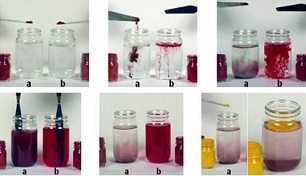
      Pigment refers to a class of organic matter that insoluble in water, not soluble in the use of media, but has been highly dispersed state of particles so that the colored matter is colored;Dye is dissolved in water or other solvent colorant, pigment and dyes solubility in water, as follows
Picture 1 pigment and dyes solubility in water,a-pigment, b-dye
1.3 Pigment Synonym
When we talk about pigments, there are several synonyms of pigment might be mentioned,such as color pigment, colorant,coloration,coloring agent.

2. Pigment types / classification

2.1. Classified by chemical structure
Pigment can be classified into organic pigments, inorganic pigments, organic pigments which can be divided into azo pigments and non-azo pigments, as picture 2 below

Organic pigments can classified into azo pigments and non-azo pigments, which azo pigments includes monoazo yellow, orange, diazo compounds, naphthol, naphthol AS, azo lake, benzimidazolone , Bisazo condensation, metal complexes. The non-azo pigments can further subdivided into pigments such as heterocyclic and fused ring including phthalocyanine, quinacridone, perylene and perinone, thioindigo, anthraquinone, dioxazine, isoindolinone and isoindoline, diketo-Pyrrole-pyrrole (DPP), triarylcarbonium, quinophthalone.
Inorganic pigments include titanium dioxide white, carbon and plant black, iron oxide, cadmium, lead chromate, chromium oxide green, ultramarine blue, iron blue, chrome green, phthalocyanine green, mixed metal oxides, bisovanadates , Manganese oxide (MNO).
Organic pigmentsInorganic pigments
Azo pigmentsTitanium dioxide white
Monoazo yellow and orangeCarbon and vegetable black
DiazoIron oxide
NaphtholCadmium
Naphthol ASLead chromate
Azo lakesChromium oxide green
BenzimidazoloneUltramarine blue
Diazo condensationIron blue
Metal complexChrome green
Polycyclic pigmentsPhthalo chrome green
PhthalocyanineMixed metal oxide
QuinacridoneBi-vanadate
Perylene and perinoneManganese oxide (MNO)
Thioindigo
Anthraquinone
Dioxazine
Isoindolinone and isoindoline
Diketo-pyrrolo-pyrrole (DPP)
Triarylcarbonium
Quinophthalone

2.2. Classified by chromatography
Pigment can be divided into red, yellow, blue, green, orange, violet, white, black, brown pigment, they are not all independent of each other.There is a certain internal relationship between colors, as we all known, a color is determined by three parameters , which are, hue, chroma, value.
2.3. Classified by application 
Pigment can be divided into ink, paint, plastic and other pigments.
2.4. Classified by color index 
The famous "Color Index" Color Index is a color classification method, pigment is classified into pigment yellow (PY), pigment orange (PO), pigment red (PR), pigment violet (PV), Pigment Green (PG), Pigment Brown (PBr), Pigment Black (PBk), Pigment White (PW), Metal Pigment (PM) according to Color Index.
2.5. Classified by compound contained
Pigment can be divided into organic pigments, inorganic pigments,

Inorganic pigments can be divided into oxide, chromate, sulfate, carbonate, silicate, borate, molybdate, phosphate, vanadate , Ferricyanides, hydroxides, sulfides, metals etc.

Organic pigments can be classified into polycyclic pigments such as azo pigments, phthalocyanine pigments, anthraquinones, indigoids, quinacridones, dioxazine,polycyclic pigments based on the chemical structure of the compounds.
2.6. Pigment nomenclature
2.6.1 C.I. Generic Name or C.I.index
C.I. Common name, is the dye index (Color Index) or Generic name (Generic Name) abbreviation for each organic pigment, for example C.I. Pigment Red 139; C.I. Pigment Red 179; etc.
2.6.2 CAS number
Known as CAS RN, CAS registry number, also known as CAS #  is a substance (compound, polymer materials, biological sequences (Biological sequences), mixture or alloy)  unique digital identification number.

3. How does pigments work ?

Mechanism of pigments is most pigments work by absorbing certain wavelengths of light. Other wavelengths are reflected or scattered, which cause you to see those colours.